
This article is part of our Play, Relaxation, and Mindfulness Summer Series, where we explore small ways to slow down and reconnect with yourself during the warmer months.
If you are new to the series, you can start with the main guide:
A Season for Play, Relaxation, and Mindfulness.
If you would like a deeper explanation of the concept behind this approach, you can also read Parallel Play With Children: Connection Without Pressure (Part 1).
In Part 1, we explored what parallel play is and why it can support both parents and children. In this article, we will focus on practical examples of parallel play that can easily fit into everyday family life.
Parallel play does not require a special setup or elaborate activities. In many cases, it simply involves sharing space while each person focuses on their own activity.
Parallel Play at Home
Home environments often offer natural opportunities for parallel play.
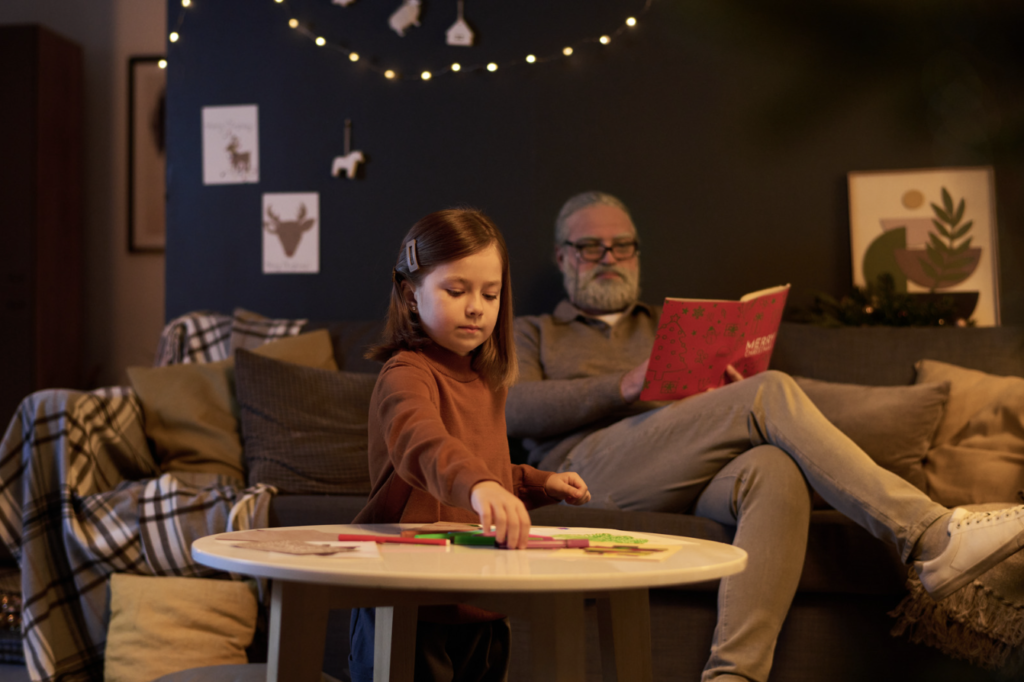
For example, a child might sit at the kitchen table drawing or coloring while a parent reads, journals, or works on a small project nearby. A child might build with blocks on the floor while the parent folds laundry or organizes something at the same table.
Both people are engaged in their own activity, but they remain aware of one another and share the same space.
This kind of relaxed presence allows children to explore their interests while still feeling connected to a trusted adult.
Parallel Play Outside
Outdoor environments can make parallel play feel even more natural.
A child might play in the sandbox while a parent tends to the garden. A child might explore rocks or sticks in the yard while a parent reads a book on the patio. At a park, a child might climb and explore while the parent sits nearby sketching, reading, or simply enjoying the environment.
Because outdoor play tends to be more open-ended, it often supports independent exploration while maintaining a sense of shared experience.
Parallel Play During Creative Activities
Creative spaces are another natural setting for parallel play.
A child might paint while a parent works on a craft project nearby. A child might build with Lego or blocks while a parent completes a puzzle or writes in a notebook.
In these moments, the adult does not need to guide or instruct the activity. Instead, both people remain engaged in their own creative process.
This type of environment can feel calm and focused rather than overstimulating.
Why Parallel Play Feels Relaxing for Parents
Many parents feel pressure to constantly organize or lead their child’s activities. Over time, that level of engagement can become exhausting.
Parallel play offers a different rhythm. Instead of directing the activity, the parent simply remains present.
This can reduce the stress that sometimes contributes to emotional overwhelm in busy family life.
Children still experience connection, but the adult does not need to perform the role of constant entertainer.
Let Connection Be Simple
Parallel play reminds us that meaningful connection does not always require constant interaction.
Sometimes the most supportive thing a parent can offer is calm presence. Sitting nearby while a child follows their own curiosity can create a sense of safety, independence, and shared experience all at once.
These quiet moments—side by side, each absorbed in your own activity—often become some of the most peaceful parts of the day.
Parallel play allows families to spend time together in a way that feels relaxed, natural, and sustainable.